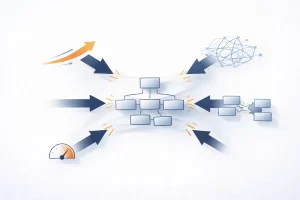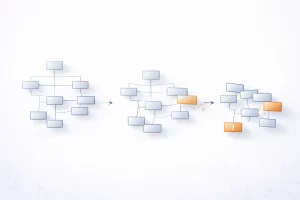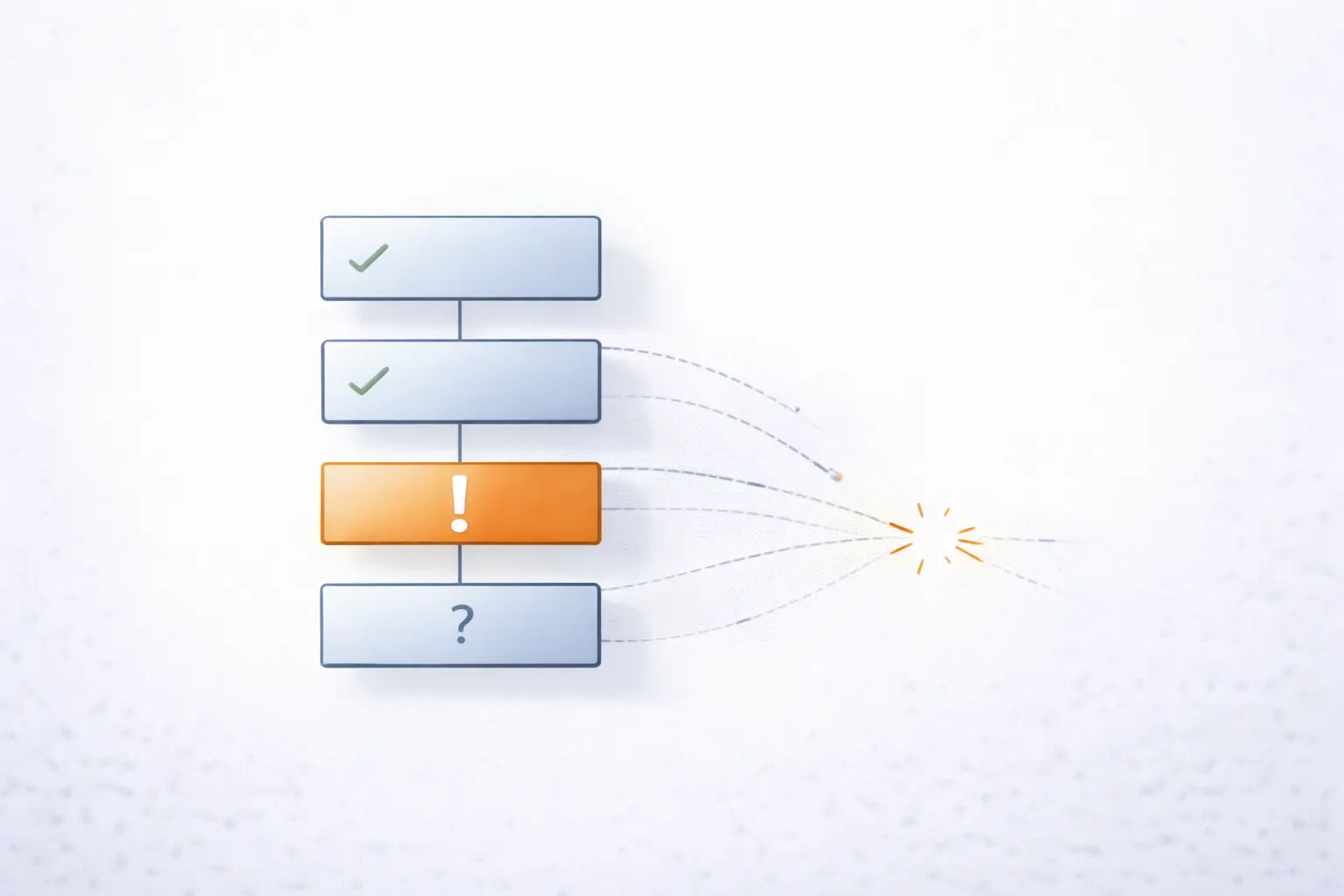
In many companies, leaders need to assess organizational effectiveness even when there is no clear trigger to redesign the organization.
There is no major restructuring underway. No crisis forcing immediate action. No obvious breaking point.
And yet, something does not feel right.
Execution is slower than it should be. Opportunities take too long to capture. And results fall short of what the strategy suggests should be possible.
In these situations, leaders often sense that the organization is not working as well as it should. But it is not always clear why or what exactly needs to change.
It is common to respond by focusing on visible issues. Decision-making seems slow, so governance is questioned. Teams are not aligned, so collaboration becomes the focus. In some cases, attention turns to individuals or isolated process improvements.
While these actions may help, they often miss a more fundamental question: what does the organization actually need to be good at to deliver its strategy?
This is where a more structured assessment becomes valuable.
When should you assess organizational effectiveness?
Leaders do not usually assess organizational effectiveness out of curiosity.
In most cases, there is already a sense that something is not working as well as it should.
Performance may not be where it needs to be. Execution feels harder than expected. Or results are not fully reflecting the strategy that has been defined.
At this stage, the situation is often not clear enough to justify a full organizational redesign. But it is also not comfortable enough to ignore.
In more explicit situations, such as major strategic shifts or structural challenges, the need for change becomes clearer. We explore these triggers in more detail in our article on the top reasons companies redesign their organizations.
You may find yourself asking:
- Is our organization actually set up to deliver what we need?
- Are we focusing on the right problems?
- Where should we improve, and what really matters?
This is where assessing your organization’s effectiveness becomes valuable.
It helps you confirm whether your initial intuition is correct and, more importantly, understand where the real gaps are before jumping into solutions.
Without this step, organizations often move too quickly into adjustments that seem reasonable but do not address the most important issues.
What does an effective organization actually mean?
In one of his books, Peter Drucker states that every executive needs to be effective, meaning the ability to get the right things done.
The same logic applies to organizations. An effective organization is one that consistently delivers its strategy and achieves the results it aims for.
This means effectiveness is not an abstract concept. It depends on what the organization needs to accomplish.
An organization is only effective relative to what it needs to be good at to succeed.
To deliver its strategy, an organization needs to perform well in a set of critical capabilities. If those capabilities are weak, the expected results will not fully materialize, even if the organization is strong in areas that matter less for the strategy.
The approach to assessing organizational effectiveness presented in this article is built on this idea. It helps you identify the critical capabilities that matter most and understand where your organization is falling short.
A practical approach to assess organizational effectiveness
To assess whether your organization is truly effective, you need a structured way to move from a general sense that something is not working to a clear understanding of what needs to change.
The approach presented here is designed to do exactly that. It focuses on what really matters for your strategy and helps you avoid jumping too quickly into isolated fixes.
It is built around four steps:
- Clarify your strategy
- Identify the critical capabilities
- Assess how strong those capabilities are
- Identify what is preventing those capabilities from developing
Each step builds on the previous one. Skipping steps or changing the sequence often leads to incomplete or misleading conclusions.
Step 1. Clarify your strategy
If organizational effectiveness is about delivering your strategy, this is where you must start.
Before assessing the organization, you need a clear view of what it is expected to deliver. Without that, it is impossible to define what “effective” actually means.
There are different ways to think about strategy. One practical and widely used perspective, developed by Roger Martin, defines strategy as a set of integrated choices that position a company to achieve superior performance.
In his work, strategy is framed through a broader set of questions. For the purpose of assessing organizational effectiveness, three of them are particularly critical:
- What are your goals and aspirations?
- Where will you play?
- How will you win?
These choices are interconnected and need to reinforce each other:
- Your goals define what success looks like.
- Your “where to play” choices define the domains in which you will compete.
- Your “how to win” choices define how you will create advantage in those domains.
Together, they define what your organization must be able to deliver.
If these elements are not clear, it is worth pausing here.
Trying to assess or improve the organization without a clear strategy often leads to discussions that are disconnected from what actually matters.
Let’s look at each of these questions in more detail.
What are your goals and aspirations?
Start by clarifying what you want your company to achieve over time.
This should go beyond financial targets. It should reflect the value you aim to create for customers and the position you want to build in the market.
A clear aspiration helps align the organization, guide decisions, and provide a reference point to measure progress.
It also sets the context for all the choices that follow.
Where will you play?
The second question defines the domains in which your business will compete.
This typically involves making choices across several dimensions:
- Geographies: Which countries, regions, or cities will you serve?
- Customer segments: Which types of customers are you targeting?
- Products and services: What will you offer?
- Value chain: Which parts of the value chain will you operate in?
- Channels: How will you reach your customers?
These choices are interconnected. The domains where you choose to play must be consistent with your aspirations and reinforce your overall positioning.
How will you win?
Once you have defined where you will play, you need to clarify how you will create advantage in those domains.
- Will you offer a distinctive value proposition for a specific segment?
- Will you compete through superior service, cost efficiency, or innovation?
- Will you leverage unique partnerships or distribution models?
There are many ways to win. What matters is making clear choices about how your company will stand out and succeed.
When to stop and clarify your strategy first
If your strategy is reasonably clear, this step should not take long. In many cases, it can be articulated in a simple one-page document and refined through discussion with a few key people in the organization.
If this is not the case, it is worth pausing here.
Trying to assess or improve the organization without a clear strategy will lead to discussions that are disconnected from what actually matters.
If you want to explore strategy more deeply, Roger Martin’s work is a good place to start, particularly Play to Win: How Strategy Really Works.
Step 2. Identify your organization’s critical capabilities
Once your strategy is clear, the next step is to understand what your organization must be able to do well to deliver it.
This is where many organizations struggle.
Instead of identifying what truly drives performance, they often focus on structures, functions, or ongoing initiatives. While these elements are important, they do not define what the organization must excel at.
A more useful lens is to think in terms of critical capabilities.
A critical capability is something your organization must consistently do well to achieve its strategy. It is not a function, a process, or a specific initiative. It is an outcome-oriented ability that drives performance.
Illustrative example
Consider a professional services firm.
If the company chooses to focus on small and mid-sized clients, one of its critical capabilities is likely to be efficient customer acquisition.
This may require generating a high volume of qualified leads, maintaining short sales cycles, and operating with a relatively low cost of acquisition.
Now consider a firm focused on large enterprise clients.
In this case, efficient customer acquisition is less critical. Instead, capabilities such as managing complex client relationships or delivering highly customized solutions may become more important.
The difference is not in the structure itself, but in what the organization needs to be good at to succeed.
Distinguishing capabilities from activities
When identifying capabilities, a common challenge is distinguishing them from the activities that support them.
For example, inbound marketing may be one of the activities that supports the capability of efficient customer acquisition. But it is not the capability itself.
Capabilities sit at a higher level. They represent what the organization must achieve, not how it does it.
This distinction is important because it keeps the focus on outcomes rather than prematurely jumping into solutions.
Building a coherent set of capabilities
Critical capabilities rarely operate in isolation.
They reinforce each other and form a system that supports your strategy.
While it may be possible for competitors to replicate individual activities, it is much harder to replicate a coherent set of capabilities working together.
In practice, this is an iterative exercise.
You and your leadership team will identify, refine, and challenge the list until it reflects what truly matters for your strategy.
A typical outcome is a set of five to seven critical capabilities that define where the organization must excel.
This set defines where your organization needs to excel.
Once this is clear, the next step is to assess how strong your organization is in each of these capabilities.
Step 3. Assess how strong your capabilities are
In practice, this is often where organizations gain their first real clarity on what is not working.
Once you have identified your critical capabilities, the next step is to assess how well your organization performs in each of them.
The goal is to understand where you are strong, where you are falling short, and where the most important gaps are.
Define what “good” looks like
Before assessing performance, you need a clear view of what excellence means for each capability.
This should be as concrete as possible.
In some cases, you can define clear metrics. In others, you may need to rely on qualitative indicators. Either way, the objective is the same: make expectations explicit.
For example, if one of your critical capabilities is efficient customer acquisition, excellence might involve:
- A high proportion of inbound leads
- A consistent flow of new opportunities
- A cost of acquisition aligned with your business model
The exact definition will depend on your strategy.
What matters is having a clear reference point to assess performance.
Assess your current performance
Once expectations are clear, the next step is to evaluate how your organization is actually performing.
This often involves combining data and judgment.
Where possible, use quantitative indicators to highlight gaps. For example, comparing current performance with defined targets.
At the same time, many capabilities cannot be fully captured by metrics alone. In these cases, it is important to complement the analysis with informed qualitative assessment.
This step requires input from different parts of the organization. Involving key leaders helps ensure that the assessment reflects reality and builds shared understanding.
In many organizations, HR plays a central role in structuring these discussions and connecting strategic priorities to organizational choices. We explore this role in more detail in our article on why HR should lead organization design.
Identify the most important gaps
The objective is not to produce a detailed scorecard.
It is to identify where the most critical gaps are.
Some capabilities may already be strong enough. Others may require significant improvement. In many cases, a small number of gaps will explain a large part of the performance issues.
Focusing on these priority gaps is essential.
Without this focus, organizations tend to spread efforts too broadly and dilute impact.
Once the main gaps are clear, the next step is to understand what in your organization is preventing these capabilities from developing as they should.
Step 4. Identify what is preventing your capabilities from developing
By this point, you have a clear view of your critical capabilities and the gaps you need to address.
The next step is to understand what in your organization is preventing those capabilities from developing as they should.
This is where the analysis moves from performance to organizational design.
Look beyond the symptoms
At this stage, it is tempting to focus on visible issues.
Decision-making seems slow. Collaboration feels difficult. Execution lacks consistency.
While these observations are useful, they are often symptoms rather than root causes.
The goal here is to understand what is structurally driving these issues.
Three areas to investigate
In practice, most of the issues affecting your capabilities will be rooted in three elements:
- Organizational structure and key roles
- How work gets done
- Performance metrics and incentives
1. Organizational structure & key roles
Start by understanding how responsibilities are distributed across the organization.
Which areas and roles are accountable for each critical capability?
This simple mapping often reveals important issues.
Some capabilities may not clearly belong to any area. Others may be fragmented across multiple teams, leading to lack of ownership or coordination.
These gaps in accountability can significantly weaken performance.
When structural changes are needed, it is important to approach them systematically. We outline a structured approach in our guide on organizational structure design: how to build the right structure.
2. How work gets done
Next, examine how the organization actually operates.
How do key processes linked to each capability work in practice?
How are decisions made?
Where do delays, rework, or misalignment occur?
This requires going beyond formal descriptions and understanding how work really happens.
Conversations with people involved in these processes are essential to uncover what is not working well.
In many cases, issues such as unclear decision rights, unnecessary layers of coordination, or ineffective meetings become visible at this stage.
3. Performance metrics and incentives
Finally, assess how performance is measured and reinforced.
Are the metrics aligned with the capabilities that matter most?
Do incentives encourage the behaviors required to strengthen those capabilities?
Misaligned metrics and incentives often lead to unintended behaviors.
Teams may optimize for what is measured, even if it does not contribute to the capabilities that drive performance.
From symptoms to root causes
By analyzing these three elements, you can move beyond surface-level observations and identify the underlying drivers of your capability gaps.
At this point, you should have a clear and focused understanding of why your organization is not performing as expected.
Rather than a long list of disconnected problems, you will have a clear link between:
- what your organization needs to be good at
- where the gaps are
- and what is preventing improvement
This clarity is essential before making any changes to your organization.
A common mistake: evaluating the organization in isolation
A common mistake when assessing an organization is to focus directly on visible issues.
Decision-making feels slow. There are too many meetings. Collaboration is difficult. The structure seems too complex or unclear.
These observations are familiar and often valid. But when assessed in isolation, they can be misleading.
They describe how the organization operates, but not whether it is effective in delivering what it needs to.
Organizational effectiveness is not determined by how “clean” or “efficient” the organization looks in general terms.
It depends on whether the organization performs well in the areas that matter most for its strategy.
An organization may have fast decision-making, lean structures, and well-defined processes, and still underperform if it is not strong in the capabilities required to succeed.
Conversely, some organizations operate with apparent imperfections, yet perform well because they are strong where it matters most.
This is why it is critical to start from strategy and capabilities before evaluating how the organization works.
Without this perspective, organizations often optimize what is visible rather than what actually drives performance.
From assessing organizational effectiveness to action: where to focus
By following these steps, you move from a vague sense that something is not working to a structured way to assess organizational effectiveness and understand what needs to change.
The objective is not to analyze everything in detail, but to identify the few capability gaps that have the greatest impact on performance and the organizational issues behind them.
This shift is critical.
Without it, organizations tend to spread efforts too broadly or implement changes that do not address the underlying problems.
With it, you can prioritize where to act and make targeted adjustments that improve performance.
In many cases, this does not require a full organizational redesign.
Progress often comes from a series of focused changes, implemented over time, with a clear logic guiding decisions and trade-offs. We discuss how to manage this effectively in our article on how to manage small but frequent organizational changes.
Do you have a clear view of your organization’s effectiveness?
If you are questioning whether your organization is truly set up to deliver your strategy, this is often a signal that it is worth stepping back.
In many situations, the issue is not a lack of effort, but a lack of alignment on what matters most and where the main gaps are.
In our experience, the most important step is identifying which capabilities are truly critical for your strategy and understanding what may be preventing them from developing as they should.
If this is a question you are currently facing, we can help you structure that assessment and clarify where to focus.
Even if the situation is not fully defined, a short conversation can help clarify priorities and next steps.
You can contact us through our contact form or send us a message at [email protected], and we will reply shortly.