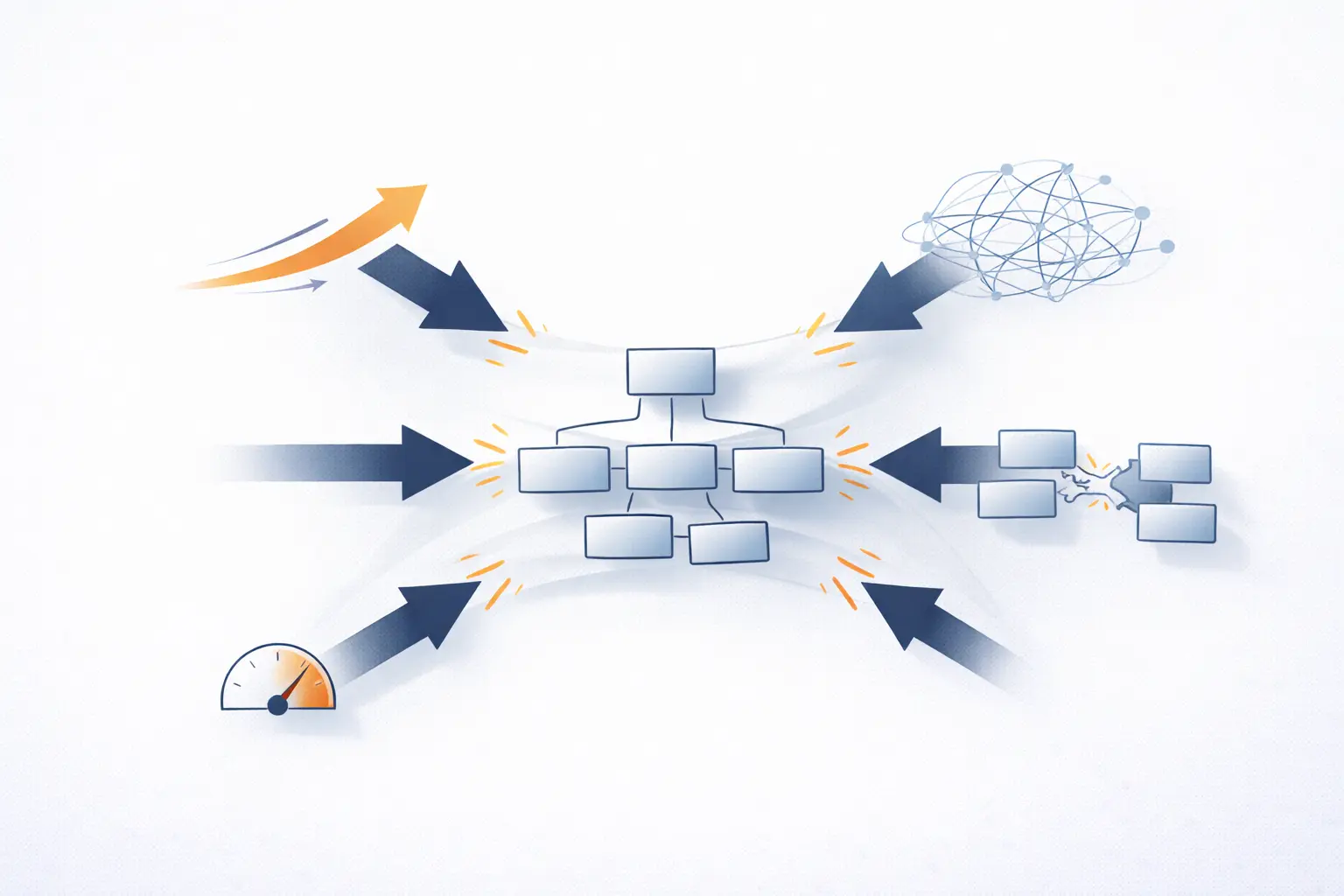
Organizations don’t redesign themselves for fun. In fact, they do it under pressure. There are four common reasons for organization design that consistently prompt companies to rethink how they organize and operate:
- A new strategy
- Post-M&A integration
- An efficiency push
- Rapid growth
Each situation is different, but they all require the same thing: a thoughtful, business aligned redesign of how work gets done. In all of them, leaders benefit from having a clear perspective on how effective the current organization really is, what is working well, where friction exists, and which capabilities need to improve.
With that perspective in mind, four situations consistently lead companies to rethink how they organize and operate.
Reason 1. New Strategy: Aligning Structure with Strategic Shifts
A new strategy means new choices about where to play and how to win. Maybe the company is entering new markets, focusing on different customer segments, or shifting its value proposition.
As a result, strategy changes what the business needs to be good at. That, in turn, should change how the business is organized.
A common trap is assuming a new strategy can succeed without changing the organization itself. Leaders announce big shifts (e.g., entering new markets, targeting new customers, launching new products), but keep the same structure, roles, and ways of working.
The result is misalignment. Teams struggle to execute, decision-making slows, and critical capabilities don’t get built.
Org design is not an afterthought. It is what turns strategy into reality. Without it, even the best strategy remains just talk.
Reason 2. Post-M&A Integration: Designing for the Combined Company
After a merger or acquisition, integration isn’t just about combining systems or cutting costs. The starting point should be the strategy of the new, combined entity.
How should the new organization work to fulfill that strategy? That question should guide design decisions.
Yes, it may mean preserving elements from Company A or Company B. But it might also require an entirely new structure and operating model. It’s to create a clear, coherent model that reflects the strategy of the combined business.
Compromise often leads to confusion. Clarity drives performance.
Reason 3. Efficiency Push: Cutting with Purpose, Not Panic
When margins tighten or forecasts are missed, companies often rush to cut. However, without clear design logic, cuts can be arbitrary or even damaging.
The right org design process helps companies identify inefficiencies while protecting the capabilities that drive long-term value.
It’s not just about trimming costs. It’s about protecting the capabilities that matter most and designing for efficiency without losing what makes the business competitive.
Reason 4. Rapid Growth: Staying Coherent Amid Complexity
When companies scale quickly (new markets, new teams, new products), complexity explodes.
In those moments, leaders need real-time visibility into what’s working, paired with the discipline to allocate resources where they matter most.
They also need the ability to adjust structure and ways of working through frequent, smaller organizational changes, while keeping the overall design coherent.
In contrast, too little design leads to chaos. Too much leads to paralysis. The challenge is finding the balance.
One Process, Many Contexts
Each reason for organization design is different, but the core design logic stays the same:
- Use the right approach to model the organization for its new reality
- Engage the right people at the right time to shape and own the design, with HR often playing a key role in facilitating these discussions and ensuring design decisions are well-grounded
- Implement with a recognition that slides don’t change behavior, people do
Before you begin, make sure you truly understand your starting point. Assess the current effectiveness of your organization: what’s working well, what’s slowing you down, and where the real friction lies. This diagnostic step is non-negotiable: it’s what grounds your redesign in reality rather than assumptions.
And as you rethink the structure, steer clear of the classic pitfalls in structure changes, the biggest being the belief that simply changing the organizational structure is enough.
A Final Note: What About New CEOs?
We often get asked whether a new CEO is another reason for organization redesign. It can be. But in our experience, those CEO-driven shifts almost always connect back to one of the four scenarios above. New leaders bring new strategies, new priorities, or new performance pressures, all of which lead back to org design.
Are you considering whether your organization needs to be redesigned?
Strategy shifts, integrations, efficiency pressures, and rapid growth often signal that the current organizational setup may no longer fully support what the business needs to achieve.
Recognizing the need for change is rarely the hardest part. The real challenge is understanding where the underlying issues lie and how to approach the redesign in a structured way.
If you are reflecting on similar questions in your organization, we would be happy to exchange perspectives. Even if the situation is still evolving, a short conversation can often help clarify where to focus first.
You can reach out through our contact form or send us a message at [email protected], and we will reply shortly.