Many organizations still treat structural change as a one-time exercise, a project to complete rather than a capability to build. In our experience working with leadership teams on organization design and operating model transformations, this mindset often limits how effectively companies adapt over time.
Yet building strong HR organization design capability is one of the most powerful and enduring sources of advantage a company can develop.
The ability to continuously adapt an organization’s design enables agility, alignment, and long-term performance. But doing so requires a clear understanding of how effective the organization currently is and where structural friction may exist.
There’s growing discussion about how HR can become more strategic, for example, by helping leaders see the true costs and impact of outdated workplace policies, practices, and mindsets. Harvard Business Review recently highlighted this evolving role.
Yet one area receives far less attention: organization design. And the potential for HR to lead it is enormous. Few topics have greater influence on how strategy is executed, how decisions are made, and how effectively people work together.
Organization Design Is a Continuous Leadership Responsibility
There will always be moments when larger transformations are needed, such as after a strategic shift, a merger, or periods of rapid growth, situations that commonly trigger broader organization redesigns.
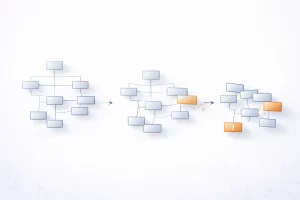
But even these efforts rarely produce a perfect design on the first attempt. New operating models must be tested, refined, and adapted based on real-world learning.
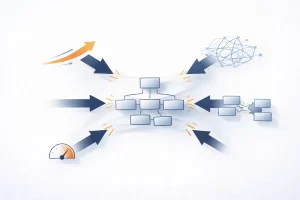
Meanwhile, smaller organizational shifts are happening all the time. Teams evolve, roles change, and priorities shift, often in ways that, over time, create hidden inefficiencies and undermine performance.
Managing organizational change, therefore, isn’t a periodic project. It’s a continuous responsibility.
At ThinkOrg, we view organization design not as a one-off effort, but as an ongoing leadership discipline, one where HR should play a central and proactive role.
Here’s why this matters, and how HR can take the lead.
Why HR’s Role Must Include Organization Design
Organizational design should sit at the heart of HR’s mandate, not just advising on spans and layers, but leading a broader conversation:
- Is our structure truly aligned with our strategy?
- Are we operating as an integrated, cohesive organization?
- Do we have the right capabilities and decision-making mechanisms to deliver on our priorities?
Yet in many companies, this conversation isn’t happening. Even in large, complex organizations, HR often isn’t fully equipped (or empowered) to lead it. That’s a major missed opportunity.
At ThinkOrg, our work focuses on helping companies redesign their organizations and reshape their operating models to achieve better results. But we also believe that every organization should be able to manage these changes more effectively on its own. HR plays a central role in making that possible.
With its unique independence and cross-enterprise perspective, HR is well positioned to help business leaders navigate organizational evolution. Even when external support is needed, HR should stay actively involved, ideally driving the process, or at the very least, contributing meaningfully to the design discussions and implementation planning.
The Organization Design Capability Gap
In many organizations, HR isn’t clearly positioned or equipped to play an active role in defining how the business is structured or how new operating models take shape. Even when HR has a seat at the table, teams often lack the tools, frameworks, or confidence to lead the process effectively.
This gap matters. Organizational design decisions are often too sensitive for the CEO’s direct reports to tackle alone. These discussions inevitably touch on the scope, influence, and priorities of senior leaders, and without a well-structured process, they can easily trigger defensiveness or political tension.
As a result, meaningful conversations about organization design often don’t happen unless the CEO personally drives them. Yet not every CEO does, whether because of discomfort, competing priorities, or other pressures.
When the CEO’s direct reports try to manage design changes themselves, the result is usually optimization by function, business unit, or region. Each leader fine-tunes their area in isolation, without stepping back to ask: Is this the right overall model for the company?
That’s a risky pattern. It creates organizations that spend time and energy improving individual parts without considering the whole or the more fundamental questions.
Why HR Is Uniquely Positioned to Close the Gap
Even when the CEO actively champions the agenda, HR’s role remains critical. HR provides the structure, objectivity, and cross-enterprise perspective that keep the process grounded and balanced. Business leaders naturally see the organization through the lens of their own areas, often with competing priorities, even when intentions are aligned.
HR is uniquely positioned to ensure the organization is designed to perform
This is where HR can make a real difference. As a neutral, enterprise-minded function, HR can connect the dots across the business, raise systemic concerns, and provoke the right questions. It can help leaders see the whole picture and challenge the status quo constructively.
HR can also provide credible alternatives and re-engage the CEO in a conversation that often gets sidelined by short-term pressures. It takes skill, perspective, and bandwidth, but the payoff is significant.
Organizations that build the capability to manage their own design decisions become far more adaptable, resilient, and high-performing. They can realign quickly as strategy and context evolve.
That’s why HR’s leadership in organization design isn’t optional. It is a strategic necessity for any company seeking agility and alignment in how it operates.
Building Capabilities in Organization Design
For larger organizations, it can make sense to establish an internal role or team focused on organization design, responsible for connecting strategy with execution. This role needs a clear understanding of how each part of the business operates and what drives success.
They also need the ability to assess and influence the key elements of effective design, including structure, processes, decision rights, responsibilities, metrics, and incentives.
Hiring someone with prior experience can accelerate progress, but the most sustainable approach is to build capability through continuous learning, especially by participating in real org design projects, whether internal or supported by external consultants.
How ThinkOrg Helps HR Build Organization Design Capability
At ThinkOrg, we help HR teams strengthen these capabilities in several ways. In business-led transformations, we ensure the HR team is fully engaged and learning throughout the process. For HR teams leading design or transformation efforts, we provide flexible support, from ongoing advisory sessions to hybrid project teams where HR professionals work alongside our consultants.
Even in smaller or mid-size organizations, where HR may not have the capacity to manage design independently, understanding the fundamentals of good design makes a significant difference. When HR knows what needs to be done and how to structure the process, any external support becomes far more effective. It means you can select the right partner, provide sharper guidance, and achieve better outcomes for the business.
Why Organization Design Capability Matters for HR
This capability shift also helps address one of HR’s longest-standing challenges: outdated perceptions about its strategic value. Some organizations still underestimate how much HR can contribute to business success.
Embracing organization design is one of the most powerful ways for HR to demonstrate its strategic impact. In a world of constant change, guiding the company through structural and operating model adjustments is both a competitive advantage and clear proof of HR’s relevance.
Because there is no business success without an organization that is designed and operating effectively. And HR is uniquely positioned to make sure the company is designed to perform.
HR Maturity Roadmap in Organization Design
We see different stages of HR maturity when it comes to organization design capability. Understanding these stages helps HR leaders assess where they are today and define where they want to be.
Stage 1: Limited HR Involvement
HR does not effectively contribute to organization design discussions. It is not consulted, or when consulted, cannot provide meaningful advice. No HR function should remain in this stage.
No HR function should remain a bystander in organization design
Stage 2: HR as an Informed Partner
HR leaders understand organization design well enough to identify issues and define what needs to be done, even if external support is required. This makes a significant difference: HR can spot problems early, help scope consulting work effectively, and drive better outcomes.
Stage 3: Building Internal HR Capability
At this stage, HR can lead and manage smaller organization changes internally with quality and confidence. For mid-size and large companies, this capability is especially valuable. Small structural adjustments happen frequently, and managing them well can have a meaningful impact on performance.
Stage 4: Advanced HR Expertise
This stage is less common but achievable in larger organizations. HR builds a dedicated team capable of managing more complex design changes internally, relying on external consultants only for major, enterprise-wide transformations.
All HR functions should move beyond Stage 1, but not every organization needs to reach the highest levels. Size, frequency of change, and business context all matter.
For large companies, reaching Stage 3 is a worthwhile goal, as smaller, ongoing adjustments often have the greatest cumulative impact. Stage 4 can be valuable when complex design work is frequent, but for many organizations, partnering with external experts as needed is a practical and efficient model.
Regardless of the starting point, strengthening HR capability in organization design is a gradual process that develops through experience and structured approaches.
Are you looking to strengthen HR’s role in organization design?
In many organizations, HR leaders recognize that organization design is critical for strategy execution, but they are still defining how their teams can contribute more actively and effectively.
If you are exploring how HR can play a stronger role in organization design in your company, we would be happy to exchange perspectives. Even an initial conversation can help clarify where to start and how to move forward.
You can reach out through our contact form or send us a message at [email protected], and we will reply shortly.