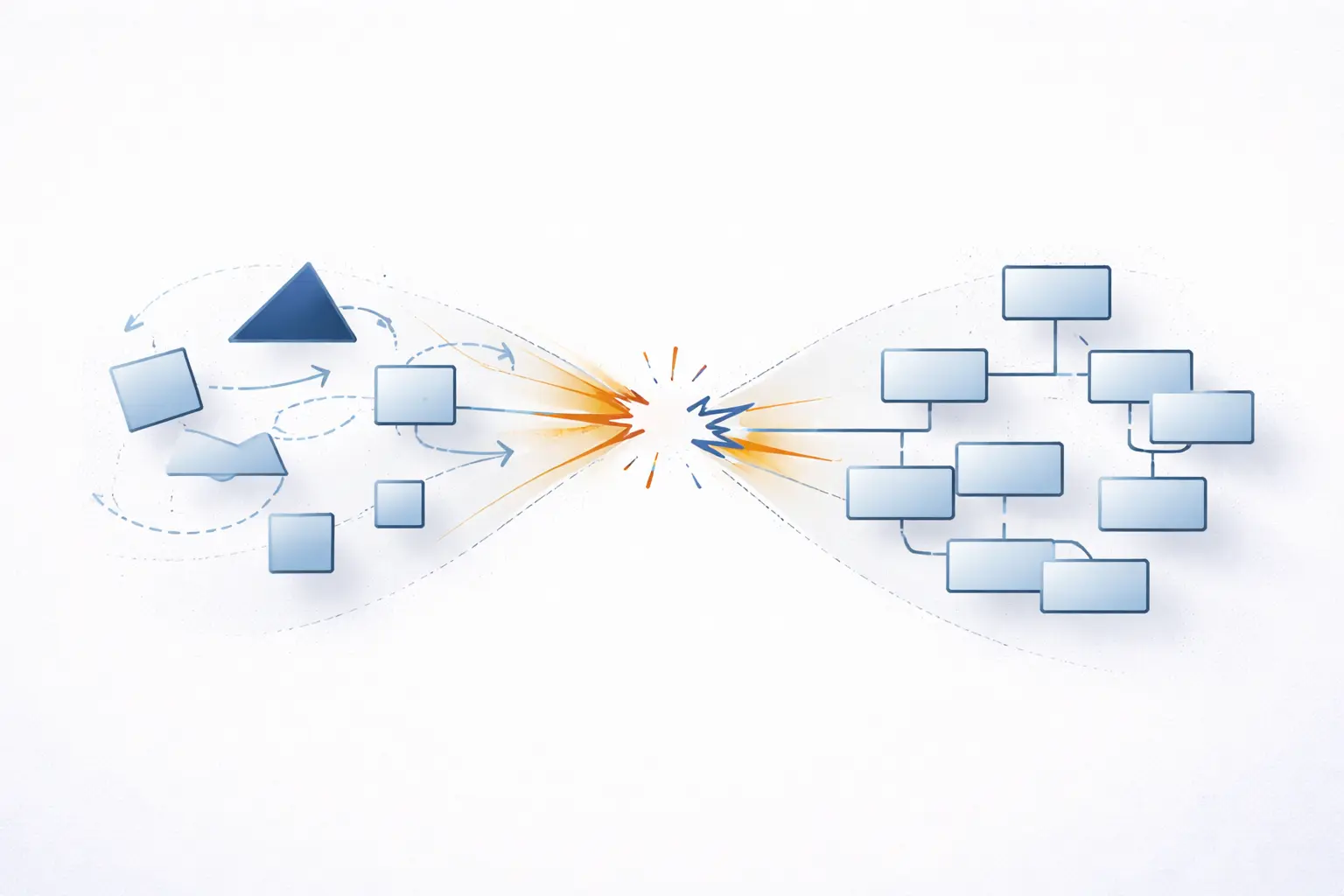
When Execution Slows Down, the Organization Is Often the Cause.
Good strategies rarely fail because they are flawed. More often, they stall in execution.
The direction is clear, the ambition is strong, and leadership teams are aligned around the new priorities. The organization mobilizes quickly, but execution still feels slower than expected.
Decisions continue to escalate. Cross-functional initiatives require constant intervention. Meetings multiply, yet coordination does not necessarily improve. Progress depends heavily on a few individuals pushing things forward across the organization.
In many cases, the problem is not the strategy itself or the level of commitment behind it. The deeper issue is that the organization continues to operate according to a previous logic, even after the strategic direction has changed.
1. Why Strategy Execution Gets Stuck Even When the Strategy Is Clear
Once the new direction is defined, organizations typically move quickly into execution mode.
Transformation offices are created to coordinate the effort. Strategic initiatives are launched. Leaders take ownership of key priorities. New KPIs appear, while executive discussions become increasingly focused on execution and follow-up.
At first, this creates momentum. Teams align around the ambition, activity increases across functions, and the organization appears energized by the new direction.
After a few months, however, the expected acceleration often fails to materialize.
Revenue from the new segment grows more slowly than anticipated. Cross-functional initiatives struggle to scale. Product development still feels constrained. Execution depends heavily on escalation and individual effort, while middle management starts to feel overloaded as meetings and coordination mechanisms continue to expand.
There are no dramatic failures, yet the organization never seems to move with the speed, clarity, or consistency the strategy now requires.
At that point, leaders often respond by increasing pressure through additional follow-up, governance, coordination, and intervention from senior leadership.
The friction, however, persists.
In many cases, the reason is structural. The company is still trying to execute a new strategic logic through an operating model designed for the previous one.
2. How Major Strategy Shifts Cause Execution to Get Stuck
When a strategic shift is significant, mobilization alone is rarely sufficient. This is often where strategy execution gets stuck, even when the ambition is clear.
But what do we mean by a significant change in strategy?
What Changes Beneath the Surface
In practical terms, it often means one or more of the following: starting to serve a new segment with very different needs, offering new types of products or services to existing customers, shifting from product to services, or changing the way the company captures value by altering the economic logic of the business.
Each of these moves may look manageable on the surface. But underneath, they change what the organization needs to be truly good at.
They redefine the set of capabilities the company must consistently excel at.
And when that happens, the way the organization is currently configured is usually no longer appropriate. It was designed for a different logic, a different set of priorities, and a different set of trade-offs.
This is why, when the change is significant, mobilization is not enough.
Mobilization means taking the existing system and applying pressure to it. It means adding initiatives, creating a transformation office, launching task forces, adjusting KPIs, and expecting the current structure and way of working to stretch and respond to new demands.
Sometimes that works for incremental shifts.
But when the required capabilities are substantially different, when collaboration patterns, decision speed, ownership logic, or customer interfaces must change, small adjustments to the existing model are rarely sufficient.
When the Existing Model Pushes Back
Transformation teams may face resistance from established structures and entrenched scopes of responsibility. Additional KPIs may struggle to counterbalance deeply rooted incentive systems. Task forces may generate energy, but they often fail to resolve the underlying interface issues between functions or clarify who truly owns the new priorities.
The result is friction.
The organization is trying to deliver something new with a system designed for something else.
To genuinely prepare the company to execute a significant strategic shift, leaders often need to rethink how the organization operates and how it is structured. There is no real shortcut to that.
And yet, many leaders hesitate, not because they disagree, but because opening up the organization feels like opening Pandora’s box. Structures may need to shift. Power may need to move. Responsibilities may need to be redefined. Difficult conversations become unavoidable.
But ignoring that deeper redesign comes at a high price.
When the change in strategy is substantial, leaders must step back and ask whether the organization itself has been reconsidered with the same rigor as the strategy.
3. Strategy Execution Breaks Down When the Operating Model Is Misaligned
It is actually not that difficult to understand why misalignment creates drag.
When strategy changes, the leadership team reporting to the CEO does not suddenly start operating according to the new direction. In reality, their work continues to be shaped by the existing system, meaning the current structure, the defined scopes of responsibility, the way collaboration has historically taken place, the meetings that already exist, the processes that guide decisions, the data that is available, and the incentives that reward certain outcomes over others.
All of these elements together drive behavior far more consistently than a strategic presentation ever will.
There is no single way to organize a leadership team that works equally well for every situation. There is no universal structure that performs regardless of strategic direction. The way a company is configured reflects the logic it was built to execute, or at least the logic it has historically optimized for.
If that logic changes but the configuration does not, friction is inevitable.
You can see this in very practical situations.
How Misalignment Shows Up in Practice
A company decides to increase cross-sell between business units, but the commercial teams rarely interact, lack visibility into the broader product portfolio, and the P&L structure remains separate with no clear ownership of shared revenue. Collaboration becomes a negotiation rather than a priority. This is a common symptom of organizational silos that prevent teams from working effectively across functions.
Another company wants to accelerate product development and creates cross-functional squads. Physically, people may sit together, but their reporting lines, evaluation criteria, and career paths still belong to the old functional silos. In critical moments, loyalty follows structure.
Or consider a company that wants to serve a new segment with smaller clients and faster cycles, but the existing processes were designed for large, complex accounts. What was once considered rigor now becomes bureaucracy.
In each of these cases, leaders may increase pressure. They may create task forces, launch transformation offices, or intensify follow-up. But they are still trying to force new behavior from a system that was engineered for something else.
Often, this means the company’s operating model no longer matches the strategy. If you want to understand how leaders rethink that system in practice, this guide on how to redesign an operating model explains the process step by step.
The problem is not commitment. It is configuration. This is often the underlying reason why strategy execution gets stuck, even when leadership intent is clear.
When the underlying elements such as structure, decision rights, incentives, processes, data, and talent allocation are not aligned with what the strategy now requires, performance slows down. Energy is spent overcoming internal barriers instead of creating external value.
No amount of mobilization can permanently compensate for a system that is pulling in a different direction.
Over time, pushing harder becomes less effective than stepping back and reconsidering how the organization is designed to operate.
4. Why Self-Reorganization Rarely Solves It
Some CEOs and BU leaders, when facing this situation, believe that the leadership team reporting to them will eventually self-organize. They assume that, given enough pressure and enough clarity about the new priorities, the team will naturally adjust roles, redefine interfaces, and resolve tensions.
Some even go further and believe that a certain level of friction or attrition is healthy, that from tension something better will emerge.
There is some truth in that. Constructive tension can lead to better solutions. This is not about avoiding conflict. But relying on self-reorganization in the context of a significant strategic shift is a risky bet for several reasons.
Why Teams Rarely Redesign Themselves
First, it is extremely difficult for peers to openly renegotiate the scope of each other’s responsibilities. These conversations are not neutral. They touch power, influence, budget, visibility, and long-term positioning. Even in mature teams, those discussions are delicate.
In practice, this often creates an unbalanced dynamic. Some executives, who may have strong ideas and valuable perspectives, hesitate to speak up because they do not want to appear as if they are encroaching on a peer’s territory.
Others, more assertive or more comfortable with ambiguity, may dominate the conversation even if their proposals are not fully thought through. Without structured facilitation and a shared framework, the process can easily become driven by personalities rather than by what is best for the system as a whole.
Second, most executives do not have a full systemic view of the organization. They see their function, their pressures, their objectives. Few truly see the entire system, or have the perspective required to identify everything that needs to be adjusted and how. They may recognize many problems and have ideas about improvements, but that does not automatically translate into a coherent redesign of the whole.
Third, redesigning how an organization works requires bandwidth. It requires structured reflection, analysis, and deliberate trade-offs. This is not something that can be solved casually between two operational meetings while still delivering monthly results. It demands focused attention and a certain degree of distance from day-to-day pressures.
What Happens When No One Owns the Redesign
In reality, what often happens is prolonged ambiguity. Tensions increase. Interfaces remain unclear. Frustration builds. Strong performers may disengage or leave, not because they resist change, but because the environment becomes structurally exhausting.
Conflict in itself is not the problem. But unmanaged structural conflict rarely produces elegant solutions. More often, it produces fatigue.
When the strategic shift is substantial, hoping that the system will redesign itself is rarely realistic. No one in the team fully owns the whole operating logic except the CEO or the BU leader. Without deliberate intervention, the existing configuration tends to preserve itself. In fact, research on executive team dynamics shows that unmanaged structural conflict rarely resolves itself without deliberate facilitation and clarity.
The risk is not open disagreement. The risk is the slow erosion of energy, clarity, and trust.
5. Strategy and Organization Must Move Together
If CEOs and BU leaders truly want to commit to a new strategy, they must ensure that the organization is configured to support it.
A strategy does not deliver results on its own. It only performs when the system behind it is aligned with what that strategy requires.
If leaders avoid revisiting how their organization is structured and how it operates, they risk under-delivering on a strong ambition. The strategy may be sound. The market opportunity may be real. But performance will remain below potential.
Often, what holds leaders back is not disagreement, but hesitation. Rethinking structure, decision rights, or ownership means entering politically sensitive territory. It may seem disruptive. It may seem time-consuming.
That hesitation is understandable.
But in many cases, the required redesign is less dramatic than imagined. It does not demand perfection or require stopping the business. What it does require is clarity about what must change and the willingness to adjust deliberately and pragmatically.
Organizational evolution can happen in steps. Adjustments can be tested, refined, and improved over time. The objective is not to engineer a flawless model from day one, but to move the system steadily in the direction the strategy demands.
Alignment Is a Leadership Responsibility
When the strategic shift is incremental, mobilization may be enough. A task force, additional focus, or reinforced accountability can deliver results because the underlying logic of the business remains largely intact.
But when the strategy materially changes what the company must be excellent at as a consequence of shifts in how it creates value, competes, and makes decisions, deeper alignment becomes critical.
If that alignment does not happen, performance will suffer. This is precisely why strategy execution gets stuck despite strong leadership intent.
Execution is often described as the ultimate differentiator. Yet execution is simply strategy expressed through an organization.
If the organization is not aligned with the new direction, execution will never reach its full potential.
Strategy requires an organization capable of delivering it.
Turning Strategy into Results
If parts of your strategy feel right but execution is not moving as expected, the issue often lies in how the organization is set up to deliver it.
In many situations, the real question is whether the operating model behind the strategy is configured to support what the company is now trying to achieve.
If you would like to explore how leadership teams typically rethink that system, this step-by-step guide to operating model redesign explains how the process usually unfolds.
Do you have questions about strategy execution and organizational alignment?
If your organization is going through a strategic shift and you are reflecting on whether the current structure and ways of working still support that direction, it can be helpful to step back and clarify what is really happening.
In many cases, the issue is not the strategy itself, but how the organization is configured to execute it.
If you would like to discuss your situation or explore how to approach these questions, feel free to reach out. Even if the issue is not fully defined yet, a short conversation can often help clarify where to focus.
You can contact us through our contact form or send us a message at [email protected], and we will get back to you shortly.