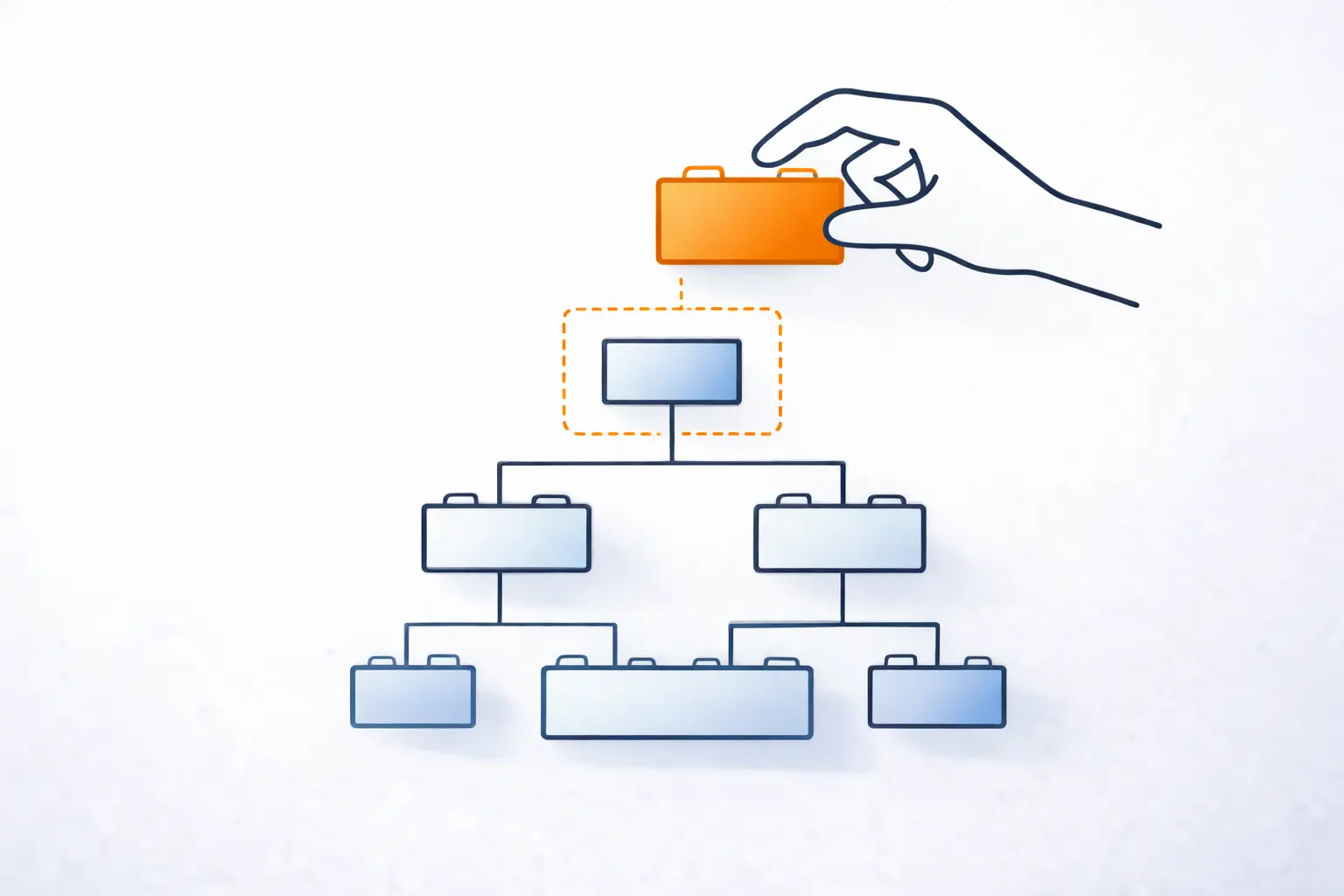
Why Organizational Structure Design Matters
Organizational structure design plays a critical role in building an effective organization. The way you design an organizational structure shapes how teams are defined, how work gets done, and how strategy is delivered.
Even with top talent, a flawed structure creates friction, execution slows, coordination suffers, and strategy stalls.
So, how should you actually approach org structure design?
Common (and Flawed) Approaches to Organizational Structure Design
When teams need to rethink structure, they often fall into one of three traps:
1. Benchmarking other players in the market
It’s tempting to look sideways and copy what others are doing, but context is everything.
What works for them likely won’t work for you. Strategy, capabilities, constraints: they all differ.
Copying an org chart might show roles, but not responsibilities. It won’t tell you how decisions are made, how work flows, or what the real priorities are.
Those elements belong to the broader operating model, not just the structure itself. If you want to explore how leaders rethink that broader system, this step-by-step guide to operating model redesign explains how the process typically unfolds.
Worse, it gives a false sense of certainty. Without the full org model — processes, decision rights, enablers — copying structure alone can backfire.
2. Choosing from a list of org models
Functional. Matrix. Customer-centric. Geographic.
These are useful labels, but they’re not a method for design.
Most real-world structures are hybrids. You might organize by customer in some areas, by function in others, and by geography where it makes sense.
Knowing the terms doesn’t tell you how to build the right structure.
You need a logic grounded in how work actually happens, not just a model to plug into.
3. Starting from a blank page
This can feel freeing, but without a clear logic, it’s risky.
You may skip over important options, overcomplicate the design, or simplify in the wrong places.
Structure design isn’t an art project. It’s a disciplined process grounded in your strategy, capabilities, and the work that matters most.
Org structure isn’t about copying what works elsewhere. It’s about building what works here.
Most org structure design starts in the wrong place.
There’s a better way: one that brings clarity, method, and context to the process.
One that starts from your strategy, not someone else’s org chart.
One that works whether you’re building from scratch or redesigning an existing structure.
The Activity-Driven Approach: A More Rigorous Way to Organizational Structure Design
At ThinkOrg, we’ve developed a methodology called the activity-driven approach to org structure design.
It blends strategic alignment with operational clarity. And it works both top-down and bottom-up.
- Top-down, because structure must reflect strategy, especially the capabilities that drive differentiation and performance.
- Bottom-up, because those capabilities come to life through specific, observable activities: the building blocks of how work gets done.
We created this approach to close a critical gap. Most org design efforts rely on high-level models or generic org charts. But without connecting to the actual work, structure remains abstract and misaligned.
The activity-driven approach creates a true bridge between business strategy and organizational structure.
Once your strategy is clear, with choices around where to play and how to win, you can identify the critical and enabling capabilities your organization must excel at.
Those capabilities translate into activities. And those activities form the foundation for your structure.
By anchoring design in the real work, not in templates or trends, we build structures that make strategy executable.
Organizational Structure Design with the Activity-Driven Approach
Step 1. Start with your critical capabilities
Identify the few organizational capabilities essential to delivering your strategy. This isn’t a laundry list.
Typically it includes 5–7 core capabilities, plus a set of enabling ones.
Step 2. Map the activities behind each capability
Now “zoom in” on each critical capability and break it into smaller, concrete activities or sub-activities.
For example, a B2B sales capability might include:
- Prospecting
- Proposal development
- Contract negotiation
- Contract signing
How granular you go is a judgment call. Start with 3–5 sub-activities per capability and adjust as needed.
Step 3. Assess specialization criteria per activity
Once you’ve mapped the activities, the next step is to ask of each one:
Would organizing this activity differently — by geography, product, customer segment, or another dimension — create real advantages?
This is where you start exploring where specialization makes sense.
For example:
- In sales, Prospecting often benefits from specialization by customer segment — say, enterprise vs. SMB. The skills, cycle times, and outreach tactics can differ significantly.
- But Contract Signing? Probably not. That activity is transactional and standardized. Specialization would add complexity without much payoff.
When the right configuration isn’t obvious, don’t force it.
Capture the viable options and your reasoning. These become inputs when you start sketching the structure.
Step 4. Create a strawman structure
With your building blocks in hand, it’s time to sketch a strawman org structure: a rough but directional blueprint.
The goal is to clarify the first-level structure: the major areas reporting to the top leader (CEO, BU head, VP, etc.). The level and scope depend on the part of the organization you’re redesigning.
Here’s the logic:
- Group activities that require similar skills and produce related outcomes.
- As you do this, check that every critical activity for your strategy is accounted for. By design, nothing essential gets left out.
- Each building block now carries its specialization criteria from Step 3. This makes your strawman more grounded than a typical first draft.
Think of it as the first sketch of your org’s top-level “map”: rough, but already grounded in the real work.
Step 5. Flesh out each organizational area
Once the strawman is in place, zoom in. Now design within each top-level area you defined.
This is where the analysis from Step 3 pays off. You already know how each activity might best be structured, by segment, geography, product line, or centralized. Use that to inform the next levels of your org chart.
This is also the stage where questions about leadership scope start to matter. As you define the next levels of the structure, you need to assess whether managers will have the right breadth of responsibility and a realistic number of direct reports. We explore that issue in more depth in our article on span of control and how to define the right number of direct reports.
Take the commercial area from Step 3: Prospecting might be split by customer segment (enterprise vs. SMB), while Contract Signing could sit in a centralized support function that serves all segments.
This step (and really the whole process) isn’t mathematical. Iteration and judgment are always required.
But the difference is: you’re no longer designing in the abstract. You’re working from a logical foundation of key activities and specialization criteria.
There will still be multiple valid options, but by design, they’re all robust and plausible. And now you have the tools to weigh trade-offs clearly and explain the rationale for your choices.
That’s the heart of rigorous org design.
Good org design doesn’t give you one perfect answer. It gives you a solid foundation for making the right trade-offs.
Why This Approach to Designing Organizational Structures Works
The activity-driven approach avoids the traps that derail most org design efforts.
- It prevents simplistic copy-paste benchmarking
- It doesn’t reduce choices to a menu of generic structure archetypes
- It ensures structure is directly aligned with strategy and the work that delivers it
- It produces a structure that reflects your unique context, not someone else’s
Of course, org design has other pitfalls too, from overcomplicating the model to designing around today’s people instead of tomorrow’s needs.
We cover those in more detail in our article: 6 Common Mistakes When Changing an Organizational Structure.
Final Thought: Let Strategy and the Work to Be Done Shape the Org Structure
Effective structures aren’t imposed. They emerge from the work the organization must perform, which in turn flows directly from its strategy.
When you redesign, follow the logic:
Strategy → Capabilities → Activities → Structure → Execution
Respecting this sequence ensures that structure is not just a chart, but a true driver of performance — one that makes strategy real.
Do you have questions about your organizational structure?
If you are reflecting on how your organization should evolve, whether because strategy has changed, complexity has increased, or execution feels slower than it should, it can be helpful to step back and clarify what is really happening.
In many situations, it helps to step back and clarify what is really driving the need to rethink the structure. Sometimes the issue lies in how responsibilities are distributed, how teams interact, or how certain activities are coordinated across the organization.
If you would like to discuss your situation or explore how to approach these questions, feel free to reach out.
You can contact us through our contact form or send us a message at [email protected], and we will get back to you shortly.